Showing posts with label Victory Gardens. Show all posts

Friday, October 7, 2011

More Digging into Victory Gardens

City of Vancouver Archives: BC Telephone Victory Garden CVA 586-1546

Yesterday I chatted with Michael Levenston at City Farmer. My neighbor Catherine had remembered meeting a Vancouver Victory Gardener with Michael and I was curious about the details. Michael said he might be able to find an article about the Victory Gardner and lo and behold he has hit the jackpot and you can read the piece on his blog. The "Last Victory Gardener" was Dr. Donald Flather and he had a Victory garden on the boulevard facing his house in Kerrisdale. My favorite part of the article, written by Kerry Banks for City Farmer in 1979, is when he asks if the Flathers have to buy any vegetables. The answer: "Yes, avocados. But not too often, we’re really not that fond of them.” Dr. Flather remembers that it was a common practice for people to grow potatoes on their front lawns and there was a time when he said there was a Victory Garden on almost every block in Vancouver. Truly amazing. Then there's also the story of his passion for painting. He sounds like a wonderful man. I wish I could have met Dr. Flather.

Another exciting discovery I made is that Ian Mosby, a Phd candidate at York University, (currently doing his post-doc at the U. of Guelph) just handed in his thesis called "Food Will Win the War: The Politics and Culture of Food and Nutrition During the Second World War" which includes interesting research on Victory Gardens. He gave me a sneak peek at one of the chapters and it's fascinating. I really hope he publishes it as a book.

So now, dear readers, I want you to do a bit of detective work. Can you figure out where that photo of the B.C. Telephone Victory Garden was taken? What is that building in the back ground? Is it city hall? If you follow this link to the digital collection from the City of Vancouver Archives you can see more photos of the gardens, so maybe you can find a few more clues. Happy detecting!

ETA: I wonder if the photo got flipped. Maybe it should be printed the other way around.

Friday, September 16, 2011

Buddies of Bud the Spud


A honeybee laden with pollen sips nectar at the Vancouver City Hall Community Garden

Besides being morale boosters, Victory gardens in Vancouver gave people "pep and energy" for the war effort and provided food for forces and the people of Britain. After the war Canadians sent food overseas to nourish people in war torn countries. Today I chatted with John from Texas who has a community plot at Vancouver city hall. He said his mother grew up in a town that was called Victory Gardens, Texas.

One gets the impression that people on both sides of the Atlantic Ocean ate a lot of potatoes. While Canada has "Bud the Bud," wartime Britain had "Pete the Potato" who was one of the personified tubers created to promote healthy eating during WWIII. I recently watched an episode of Foyle's war called "They Fought in the Fields" in which three Land Girls (women in the Land Army) struggle to plant a field of potatoes before dark. Members of Land Army get to wear snappy uniforms and their diet is supplemented by farm food, but it is back-breaking work and they must have ate, slept, and dreamed of potatoes. Not to mention the turnips, which were another war time staple, even in the gardens at Buckingham Palace.

The Canadian war artist Bruno Bobak remembers being invited in to a family's home in appreciation for the liberation of Almelo, Holland:

"We had a four-course meal, but every course was potato,'' he says. "We had potato soup, potatoes with gravy, potatoes with brown sugar. They had almost no food left."

--The Telegraph Journal

Woolton Pie was a famous recipe named after the British Ministry of food made with simple, cheap, and wholesome ingredients.

"It was named after Frederick Marquis, Lord Woolton, the ex-managing director of a store chain called Lewis (mainly in the north of England) and ex-social worker, who was appointed Minister of Food in April 1940. Unglamorous his position may have been, but it was vital to the war effort. It says much for Woolton's personal charm that he was remarkably popular with the public, even when singing the praises of rissoles without beef, cakes without sugar and tea without tea leaves."

--www.carrotmuseum.com

Those who have the will to win,

Cook potatoes in their skin,

Knowing that the sight of peelings,

Deeply hurts Lord Woolton's feelings.

--http://www.homesweethomefront.co.uk

To Make Woolton pie you cut up potatoes (with the skins on so as not to hurt Wooly's feelings), "swedes", cauliflower and carrots, and spring onions, cover with vegtable stock and a teaspoon of oatmeal and cook it. By this I gather they mean boil it to within an inch of its life. This is your pie filling. You put this in a baking dish, cover it with more potatoes or pastry and cook it in the oven. You can read more about the fascinating story behind Woolton pie at the World Carrot Museum website.

Today in France, farmers plant potatoes in former battlefields which is still hazardous. In 2007 A woman in Italy found a WWII grenade in a bag of potatoes.

"Police said the pine cone-shaped grenade, which had no pin and was still active, was the same type used by U.S. soldiers in Europe in World War Two. Authorities believe the mix-up happened at a farm in France, where the grenade was plucked from the ground along with potatoes.

To the woman's relief, police and explosives experts in the small town of San Giorgio a Cremano, near Naples, recovered the grenade and safely detonated it on Wednesday."

--Reuters

Check out this website from Dundry Nurseries where you can here Potato Pete's song and even order a reproduction of his own cookbook. You can also watch a clip of a British tv show where they show how to plant and store potatoes and grow squash on top of your bomb shelter. You can also learn how to make your own potash!(?)

The Numbers:

It was estimated that between 1917 and 1919, over five million Victory Gardens had been planted in North America, which had produced some $1.2 billion in foodstuff productions.

By the end of 1943, there were more than 200 000 Victory Gardens in Canada producing 550 lbs of produce.

--wartimehouses.com


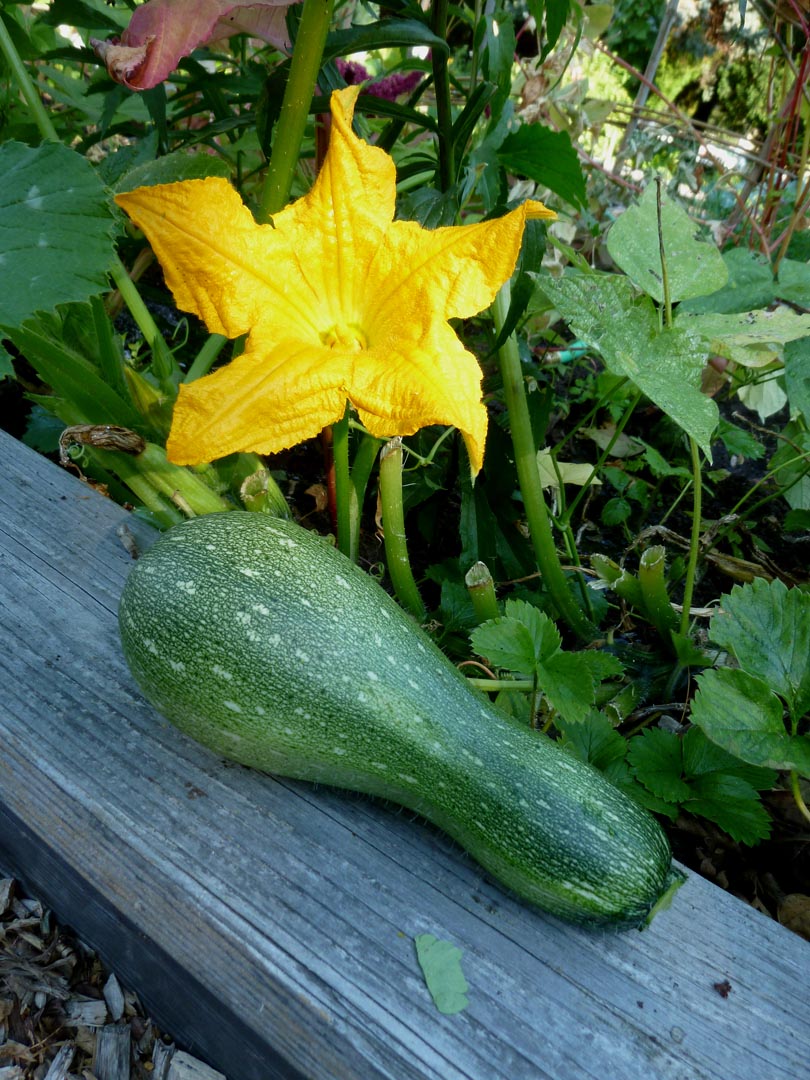
A lovely victory zucchini grown at the Simon Fraser Elementary garden at the community garden, Vancouver City Hall.

Dig for Victory!

Monday, September 12, 2011

Je suis une brave poule de guerre

Check out this WWI propaganda poster from France.

Citizens are called to be inspired by the brave war hen who eats little and produces a lot: Je suis une brave pule de guerre, je mange peu et produis beaucoup. Propaganda in WWI leaves little room for ambiguity, but some of the artwork is quite lovely. The colors and the composition in this lithograph are compelling. In 1943 Vancouverites were allowed to have a dozen chickens in their back yard without a permit. During both World Wars people were encouraged to grow their own food to save resources such as petrol and farm labor and to send the surplus produce overseas. My mom remembers sending sugar to her pen pal in England named Rosemary Coombs. My partner says his mom remembers rationing sugar by grinding up stale cookies and putting them in the cookie batter for the next batch. There was even a special war diet that helped you stay strong so that like the brave little chicken, even thought your diet was carefully rationed, you still had the energy to help the war effort and take care of your own Victory Garden.

This poster, designed by a 14-yr-old, is interesting because it is one of the earliest evidence I've seen of the concept of a Victory Garden: "Cultivons Notre Potager." In WWI they were called "War Gardens." Citizens were encouraged to eat more fish and save meat for the troops, to eat more potatoes and save bread. This American poster doesn't mince words: "Food is ammunition--don't waste it." Another American poster advises observing meatless, wheatless and porkless days.

Food:

1) Buy it with thought

2) cook it with care

3) use less wheat and meat

4) buy local foods

5) serve just enough

6) use what is left

don't waste it

--US Food Administration, 1917

Ruins into Radishes

GARDENS (aka BOMB CRATER, BLITZED GARDENS) (issue title - WHAT GOES ON?)


Thanks to Michael Levenston's blog at City Farmer, I found an excellent British Pathé film of an extraordinary Victory Garden planted by Mr. Hayes in a bomb crater located in "the shadow of Westminster Cathedral. The text has some great slogans:

Everything the average allotment grows on his plot, Mr Hayes grows in his crater.

Mr Hayes certainly how many beans make five.

That patch was one a bomb crater but Jerry didn't know he was going to say it with flowers.

What was once a bomb has now been transformed into a boon.

Ruins into radishes, litter into leeks and do these girls know their onions!

...Cabbages where cabs were ranked, Londoners can take it and grow it!

  • I am currently looking for photos of Victory gardens in Vancouver. Also, I am wondering if city hall had victory gardens in WWII where the community garden is planted right now. You can comment below or contact me here: beespeaker[at]gmail[dot]com.